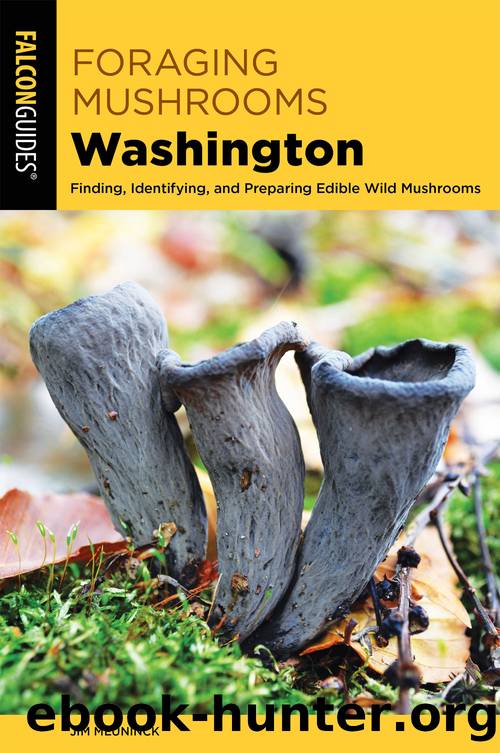
Foraging Mushrooms Washington by Jim Meuninck
Author:Jim Meuninck
Language: eng
Format: epub
ISBN: 9781493036431
Publisher: Falcon Guides
Published: 2019-05-07T16:00:00+00:00
MORELS
Morchellaceae:
Black morel (Morchella brunnea, Kuo 2012)
Yellow morel (gray when young) (Morchella esculentoides)
Gray morel (Morchella tomentosa, Kuo)
Half free cap morel (Morchella populiphila, Kuo, Carter, Moore)
Origin: Morchel is German meaning âfungus.â Tomentosa means âcovered with hairs.â
Season: Spring as measured by latitude and altitude, earlier at lower latitudes and later at higher altitudes. Found from Mar to late June in Washington. Spring as measured by blooming apple blossoms.
Identification: Morchella is a large and complex genus. Members of the genus are fairly simple to identifyâit gets more difficult to get to species. With help you can. One good resource is www.mushroomexpert.com/morchellaceae.html.
True morels belong to the genus Morchella, whereas false morels are Verpas and Gyromitras, and elfin saddles are Helvella. Of the four morels described here:
Black morels are found under oaks and other hardwoods including madrone and possibly conifers. The species was identified and named by Kuo in 2012. It is similar to the black morel of the eastern United States but smaller. Conical cap with vertically arranged ridges and pits. Ridges are black and pits lighter, brown to tan. Stipe is hollow and as long as the cap is tall. Base of stipe slightly swollen.
Yellow morels, in contrast, start out gray and mature to yellow with a full body of pits, and ridges of different shapes and sizes. Cap and stems are hollow. They can exceed 10" in height, but are typically in the 3"â6" range. Yellow morels are domestic, found in urban settings: parks, along bike trails, and in conjunction with cottonwoods (river bottoms), ash, apple, and pear trees, and along the edges of campgrounds.
Gray morels have a brain-like outer appearanceâridged and pittedâwith pits arranged in columns or laddered. Cap and stem are hollow in the middle and take the form of a jester-shaped cap that tapers. Stems darken with age and can be blackish at maturity. Mushroom ranges from 2" to 8" in height. In general, morels love rich soils with a lot of humus (or ash) and rotting fallen trees and stumps. These are mushrooms of the spring, and the mushrooms of conifer forest burnouts. Their appearance occurs in spring, the timing of which varies by latitude and altitude.
Half free cap morel caps are small, 1"â1½" wide, and proportionally the stem is long, up to 6" overall. The bottom half of the cap is free from the stem, hanging as if a skirt. When cut in half, the attachment is evident.
Spores: Cream to yellow colored
Habitat: Morels are found in almost all Washington ecosystems, valleys, mountains, coastal areas, and river bottoms, preferring some exposure to light but not dry areas. Hugh Smith finds morels in pear orchards. Gray morels are professionally harvested and commonly found in markets. They are found especially in conifer burnouts. Half free caps, more commonly found in Oregon, may be found in conjunction (under) black cottonwoods, Populus trichocarpa, growing in river bottoms.
Look-alikes: Verpas and Gyromitras : Gyromitra and false morels look similar to edible morels but have grotesque folds and are saddle shaped and brain shaped without hollow stems.
Download
This site does not store any files on its server. We only index and link to content provided by other sites. Please contact the content providers to delete copyright contents if any and email us, we'll remove relevant links or contents immediately.
Sapiens: A Brief History of Humankind by Yuval Noah Harari(14412)
The Tidewater Tales by John Barth(12674)
Mastermind: How to Think Like Sherlock Holmes by Maria Konnikova(7372)
The Thirst by Nesbo Jo(6961)
Do No Harm Stories of Life, Death and Brain Surgery by Henry Marsh(6948)
Why We Sleep: Unlocking the Power of Sleep and Dreams by Matthew Walker(6737)
Life 3.0: Being Human in the Age of Artificial Intelligence by Tegmark Max(5566)
Sapiens by Yuval Noah Harari(5383)
The Body: A Guide for Occupants by Bill Bryson(5118)
The Longevity Diet by Valter Longo(5072)
The Rules Do Not Apply by Ariel Levy(4983)
The Immortal Life of Henrietta Lacks by Rebecca Skloot(4600)
Animal Frequency by Melissa Alvarez(4483)
Why We Sleep by Matthew Walker(4456)
The Hacking of the American Mind by Robert H. Lustig(4392)
Yoga Anatomy by Kaminoff Leslie(4377)
All Creatures Great and Small by James Herriot(4335)
Double Down (Diary of a Wimpy Kid Book 11) by Jeff Kinney(4286)
Embedded Programming with Modern C++ Cookbook by Igor Viarheichyk(4188)
